

Where Faith Meets Vision: NNJS Marks 48 Years by Restoring Sight on Ram Nawami
.gif)
.gif)
.gif)
There’s something quite powerful about certain dates, they don’t just pass by, they mean something. Chaitra 13 (March 27) is one of those days. It marks Ram Nawami, the birth of Lord Ram, a figure deeply rooted in faith, ethics, and the idea of righteous living. And this year, the day carried an added layer of meaning as it also celebrated the 48th anniversary of Nepal Netra Jyoti Sangh (NNJS).

At first glance, these may seem like two very different milestones, one spiritual, one institutional. But when viewed closely, they meet at a beautiful intersection: the idea of vision.
In Hindu scriptures, Lord Ram is said to be born in the Treta Yug, an era often described as a time when righteousness still guided human life, even as complexities began to emerge. His life is not just a story of devotion, it is a story of clarity. He represents dharma: the ability to see what is right and act on it, even when it is difficult. In that sense, Ram Nawami is not just about celebrating a birth, it is about reflecting on how we see the world, and how we choose to respond to it.
That idea of “seeing” extends beyond the metaphorical when we think about the work of NNJS. For 48 years, the organization has been quietly and consistently restoring sight, preventing blindness, and making eye care accessible, especially to those who need it most. In a country where geography and resources can often limit access to healthcare, this work becomes more than service, it becomes dignity, independence, and a renewed way of living.
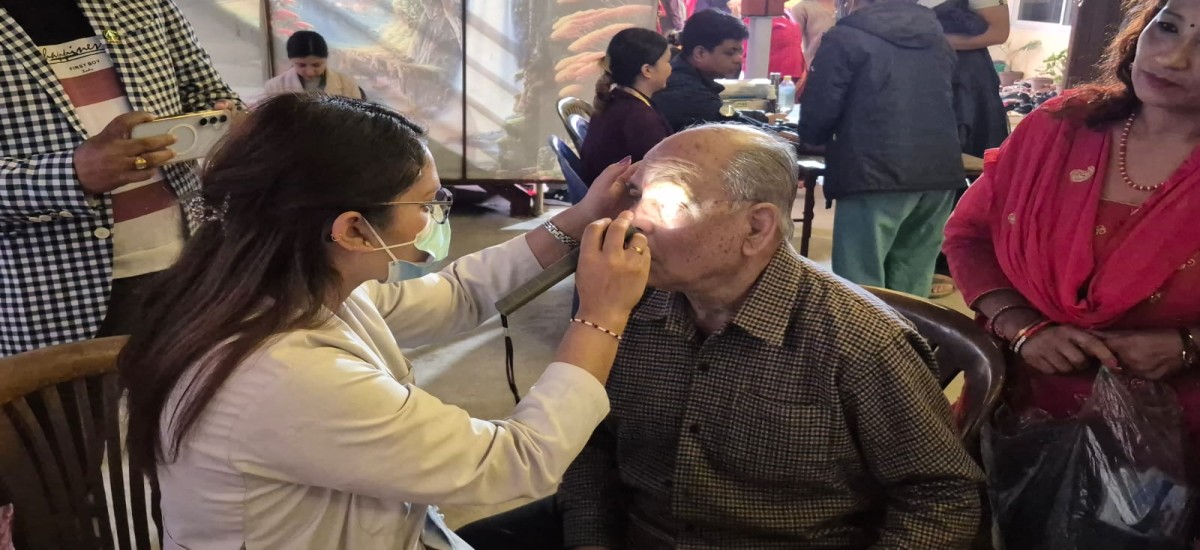
So, hosting an eye camp at Ram Mandir on this day felt deeply symbolic.
As devotees gathered to offer prayers, seek blessings, and celebrate Ram Nawami, many, especially elderly individuals, also carried unseen struggles. For some, vision had gradually faded, making it harder to navigate the very spaces they came to for peace and connection. Bringing eye care services directly to them, within that sacred space, quietly bridged two forms of care: spiritual and physical.
And the response was overwhelming.
A total of 228 individuals were screened during the camp, each one with their own story, their own reason for being there that day. Among them, 3 cases of cataract and 1 case of pterygium were identified, conditions that, if left untreated, could continue to limit vision and quality of life.
For many, immediate support made all the difference, 146 people received glasses, allowing them to return home with clearer sight the very same day. At the same time, 117 individuals were referred for further evaluation and treatment, ensuring that their journey toward better vision does not end here.
These are not just numbers. They are moments, of someone seeing their surroundings more clearly after years, of someone reading again, recognizing faces again, moving with a little more confidence than before.
It’s almost poetic, on a day that celebrates a figure who symbolizes moral clarity, people were also regaining literal clarity. The act of restoring sight became more than a medical intervention; it became an extension of compassion, a way of honoring the deeper essence of the day.
And even for those unfamiliar with Hindu traditions, the message remains universal. Every culture, every belief system, values the ability to see clearly, whether that means understanding right from wrong, or simply being able to look at the faces of loved ones. Vision, in every sense, is deeply human.
This celebration, then, was not just about anniversaries or rituals. It was about connection, between past and present, faith and service, symbolism and action.
On this Ram Nawami, as prayers were offered and lamps were lit, something equally meaningful unfolded, people walked away seeing the world a little more clearly.


प्रतिक्रियाहरू
Shares